Promising results from real-time AI interpretation
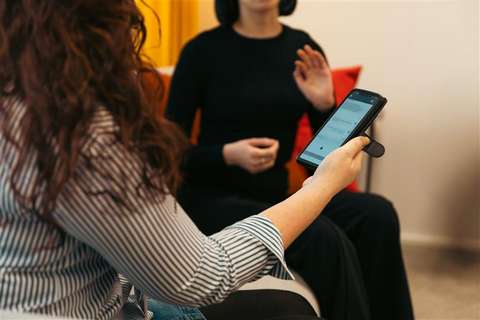
In February 2025, the wellbeing services county launched an experiment that utilises real-time AI interpretation. Some of the personnel at the Kivenlahti and Suur-Leppävaara maternity and child health clinics and social services supporting integration are taking part in the experiment. AI-assisted interpretation is being tested in Russian, Ukrainian, and Arabic.
“More than 80,000 multilingual residents live in our wellbeing services county, which is approximately 19 per cent of the entire population. As the multilingual population grows, the need for interpretation will also increase,” says Pasi Ojaniemi, Director of Support Services in the Western Uusimaa Wellbeing Services County.
The aim of the experiment is to improve the availability of interpretation services and the flexibility of the service in situations where there is no common language and to examine the impacts of artificial intelligence on the client experience and costs. The experiment is being carried out in cooperation with interpretation service provider Túlka Oy.
The experiment on artificial intelligence interpretation is part of the wellbeing services county’s goal of boldly reforming health and social services. The wellbeing services county is one of the first to introduce AI interpretation in client work. The experiment will strengthen the region’s status as a pioneer in the utilisation of artificial intelligence.
AI interpretation works and streamlines interaction - but still requires practice
So far, approximately 150 AI-assisted interpretation events have been carried out. Over the first three months, it has been observed that AI is particularly useful in short and straightforward service situations. In addition, many observations that streamline interaction have emerged, including that in addition to entire service situations, an AI interpreter supports situations in which the client speaks some Finnish, but occasionally needs confirmation in understanding more difficult issues. However, a great deal of user experience is still needed. According to feedback collected from users, AI interpretation requires practice and getting used to.
“There is enormous potential in AI interpretation. The AI interpreter is neutral, always available and the translation produced by it remains in writing to ensure quality. We will continue our experiments in a resolute manner to better understand the quality of current solutions and the most suitable uses,” says Johan Sanmark, Western Uusimaa Wellbeing Services County’s Director of Research, Development and Innovation.
The mobile application used in the experiment listens to speech, uses the language model to translate it into the selected language and repeats the translation to the client in real time. The application also produces a text version of the discussion, which enables the client and the employee to work together to ensure that the message was understood correctly. The feature has received praise from the personnel during the first months of the experiment. The speech and text versions of conversations are only saved temporarily so that the quality of the translation can be reviewed. The data is not used for training AI or other purposes.
The client always has the right to choose a traditional interpretation service, and, depending on the situation, it is possible to switch from the AI interpretation to a human interpreter in the middle of service use. It is promising that during the experiment, 82% of AI interpretations have been completed from start to finish without switching to a human interpreter.
Goal-oriented and responsible service development
“It is important that the wellbeing services counties look for responsible ways of developing their operations cost-effectively so that we can meet service needs in the future as well. AI interpretation can be one way to promote this goal,” Ojaniemi says.
AI interpretation is part of the wellbeing services county’s wider AI programme, which examines how AI can be utilised in a customer-oriented and cost-effective manner in different services. During the experiment, the wellbeing services county will collect feedback from both personnel and clients. Based on the results, it will be assessed whether AI interpretation can also be used more extensively in other services and languages.
“Artificial intelligence has extensive potential in social welfare and health care, and as a wellbeing services county we want to utilise it responsibly and effectively. Through the experiments, we are building a foundation for solutions that support future services,” Sanmark describes.