School absences

Problematic school absences among children and young people have increased in recent years at the international level. During the coronavirus pandemic, the situation became exacerbated for children and young people who were already having difficulty attending school, and the risk of completely dropping out became emphasised.
A report published in 2020 by the Finnish National Agency for Education revealed that some 2–3% of secondary school-aged children have absences that hinder their school attendance. In the 2023 School Health Promotion Study, 4% of respondents in grades 8–9 reported that they skipped school without permission at least weekly. Research results show that a 5–10% increase in absences from basic education increases the risk of absenteeism becoming problematic or chronic, and a 20% rate of absence increases the risk even further. The rate of absences usually increases gradually.

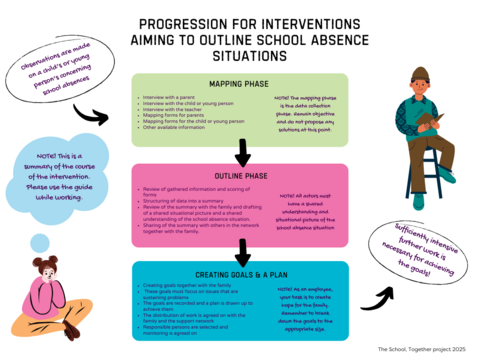
An employee survey conducted by the School, Together project in 2024 confirmed that many family centre services see a high rate of school absenteeism and challenges in families caused by prolonged school absences. In severe cases of school absence, social welfare and health care services are necessary to support the efforts of the parents and school, and it is important that everyone has a uniform understanding of school attendance problems and situations involving school absences. Early support based on a shared situational picture ensures that the problems related to a child’s or young person’s school attendance and the cycle of absence do not worsen.
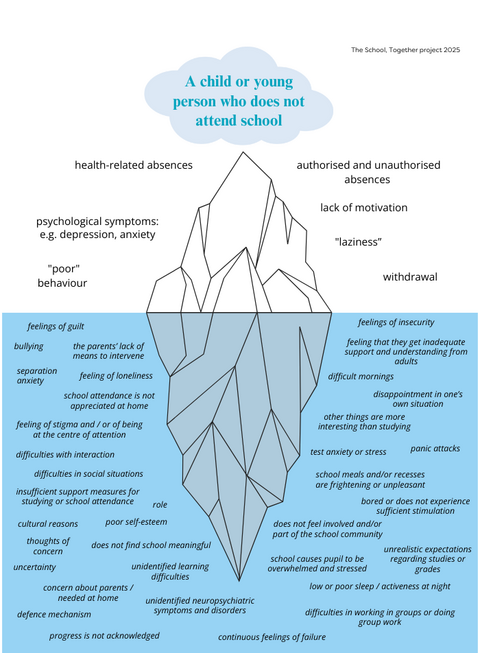
A child’s or young person’s absence from school is always an indicator of declined well-being. Research and literature highlight two main considerations for situations involving school absences. Firstly, improving a child’s or young person’s situation calls for a multi-actor approach and working together. Secondly, there is a need to form a common understanding of the situation. This is achieved by mapping out the situation extensively enough, drawing up a situational picture and sharing the results between the different parties. Addressing school absenteeism requires uniform operating models to ensure that support measures are implemented equally for all families.
Being repeatedly absent from school is always a symptom whose underlying factors must be examined to the extent required by the situation. The information generated by the examination will guide the work to address the school absence.
School refusal occurs when stress exceeds support, when risks are greater than resilience, and when “pull” factors that promote school non-attendance overcome the “push” factors that encourage attendance - Thambirajah et al 2008
Content
Tools
Intervention for structuring school absence situations:
Information on school attachment and intervening in absences
Our common school path: Handbook for supporting attendance and reducing absence in basic education http://urn.fi/URN:ISBN:978-952-263-924-0(external link) (in Finnish)
KouluKunnossa project that ran in Western Uusimaa: www.koulukunnossa.fi(external link) (in Finnish)
Finnish National Agency for Education: www.oph.fi/fi/kouluun-kiinnittyminen-ja-poissaoloihin-puuttuminen(external link) (in Finnish)
Information on organising support at school: School community | Mielenterveystalo.fi(external link) (in Finnish)
Timeout is a dialogue-based method that can be used in communal work: timeoutdialogue.fi(external link)
Video (35min.): Orastavien koulunkäyntiongelmien kartoitus - Katarina Alanko (Mapping out emerging school attendance problems) - Katarina Alanko(external link)
Research data on school absences:
Kouluakäymättömyys Suomessa -raportti. (Report on school attendance problems in Finland.) Finnish National Agency for Education (2020): Kouluakaymattomyys_Suomessa(external link) (in Finnish)
Kouluakäymättömyys sosiaalityön ja moniammatillisen yhteistyön näkökulmasta. (School attendance problems from the perspective of social work and multiprofessional cooperation.) Master’s thesis. Rontti&Ilvesluoto (2023): https://urn.fi/URN:NBN:fi-fe202301296369(external link) (in Finnish)
Kouluakäymättömyys ilmiönä lastensuojelun sosiaalityöntekijöiden ja peruskoulun opetushenkilökunnan puhetavoissa. (School attendance problems as a phenomenon in the turns of phrases of child welfare social workers and comprehensive school teaching staff.) Master’s thesis. Kähkölä (2024): School attendance problems as a phenomenon in the turns of phrases of child welfare social workers and comprehensive school teaching staff(external link) (in Finnish)
Etsivien nuorisotyöntekijöiden käsityksiä oppivelvollisuuden laajentumisen vaikutuksista koulunkäynnistä kiinnostumattomiin nuoriin. (Outreach youth workers’ perceptions of the impact of the expansion of compulsory education on young people disinterested in school attendance.) Master’s thesis. Isomursu (2024): https://urn.fi/URN:NBN:fi-fe2024110890445(external link) (in Finnish)
Kouluakäymättömyys autismikirjon oppilailla. (School attendance problems with students on the autism spectrum.) Bachelor’s thesis. Ollila (2024): https://urn.fi/URN:NBN:fi:oulu-202405113282(external link) (in Finnish)
Kouluakäymättömyys ja kouluun kiinnittyminen alakoulussa: puuttumisen keinoja ja haasteita sekä käytössä olevia tukikeinoja. (School attendance problems and school attachment in primary school: means and challenges of intervention and available means of support.) Master’s thesis. Jääskeläinen (2024). https://urn.fi/URN:NBN:fi:oulu-202407015075(external link) (in Finnish)
Nuorten koulupoissaolot: kurkistus koulupoissaolokäsitteisiin ja -tekijöihin sekä tukitoimiin. (School absenteeism among young people: a look at the concepts and factors of school absenteeism and support measures.) Pelkonen & Virtanen (2021). Puheenvuoro_NMI_3.12.2020.pdf(external link) (in Finnish)
Parents' Experiences of Addressing School Absenteeism Through Systematic Analysis. Bachelor of Social Services thesis. Vainio; Sormunen (2024) https://urn.fi/URN:NBN:fi:amk-2024121335755(external link) (in Finnish)