Daily life that works – practical tips for parents of children and young people
Practical tips for regulating children’s/young people’s overload, helping them manage everyday life and supporting their concentration at home.
This page contains information on key areas where challenges can easily affect how smoothly daily life runs and how much overload it causes. Below are practical tips for regulating children’s or young people’s overload, helping them manage everyday life and supporting their concentration at home. Even a small change can make the whole family’s daily life considerably smoother. Regular and systematic activities help introduce changes in everyday life.
Lifestyle
Lifestyle plays a key role in the help and support for concentration and attention difficulties, as it has a direct effect on the brain’s level of alertness, ability to concentrate and emotion regulation.
Regular sleep, sufficient exercise, regular meals and a clear daily structure help manage daily life and support brain functioning. Attention must also be paid to electronic media.
Having the basics of everyday life are in order helps improve concentration and functional capacity, helping the child/young person feel more balanced and making the family’s everyday life easier.
Many children and young people with concentration difficulties have sleep problems. It may be related to challenges in regulating alertness. It may be difficult to calm down in the evening and sleep may be interrupted. If it takes too long for a child or young person to fall asleep, they may not be getting enough sleep.
Sleep disruption and the resulting tiredness can affect
- concentration
- memory
- learning
- emotion regulation and mood.
People respond to sleep deprivation in different ways. Some may feel tired, others restless and irritable. Sleep deprivation can also manifest as over-alertness.
Sufficient sleep
- 6–12-year-olds: around 9–12 hours per night
- 13–12-year-olds: around 8–10 hours per night
Recipe for better sleep
- Regular meal times and a healthy diet: Pay attention to what the child/young person eats as their evening snack. It is easier to fall asleep when you have eaten enough. Eating a snack can be part of the family's evening routine. No coffee, cola or energy drinks after 17:00.
- Physical activity: Motivate and encourage regular physical activity during the day. Physical activity reduces stress hormones, which has a positive effect on sleep at night. You should avoid overly stimulating physical activity, such as rough-and-tumble play, before bedtime in the evening.
- Evening routine: Create a familiar and safe evening routine that lasts 15–30 minutes and is repeated regularly every evening. Young people also benefit from evening routines, which help them fall asleep and improve the quality of their sleep at night.
- For a preschool or primary school-aged child, e.g. an evening snack, brushing teeth, a shared reading time of 10–15 minutes, winding down in their own bed, and listening to music.
- For a lower secondary school-aged young person, e.g. having an evening snack together with family members, discussing the day’s events, light reading, listening to music, shower.
- Sleep rhythm: Going to bed at roughly the same time and getting up at a set time is recommended, including at weekends and during holidays. It is fine to stay up later on special occasions, as long as the normal routine is resumed afterwards.
- Lowering alertness levels in good time: The use of the computer and other devices (including TV) should be stopped 1–2 hours before bedtime. The blue light and engaging content of devices can maintain alertness levels, making it difficult to fall asleep. It is best to leave phones, smartwatches and similar devices outside the bedroom. A light massage or relaxation exercises can also help you calm down.
- Sleep environment: A calm, cool and sufficiently dark sleep environment creates favourable conditions for sleep. A sleep comfort toy, a heavy blanket, quiet music, a dim night light or sufficient darkness can promote calming down.
- Worry time: If the child or young person has a tendency to worry, it is a good idea to discuss with them what happened that day and talk about any worries and try to come up with solutions together in the early evening, well before bedtime.
- Bed: It is a good idea to use the bed only for sleeping and to avoid spending time on it before bedtime (reading a bedtime story/reading before sleeping is ok). Otherwise, the bed may become associated with tossing and turning and staying awake.
Regular meals and sufficient energy intake help maintain a steady level of alertness throughout the day. Eating regularly helps keep blood sugar stable, enabling the child or young person to concentrate better, learn and be active without sudden moments of hunger or fatigue.
Eating also affects mood and emotions. Regular meals support a more stable mood because the brain gets the nutrition it needs at the right time.
Nutritional deficiencies, such as insufficient energy intake or an unbalanced diet, affect coping and cognitive functioning, i.e. memory and learning, decision-making and problem-solving, and attention and concentration.
Eating meals together strengthens the sense of belonging. Give the child or young person age-appropriate tasks related to cooking and eating, such as setting the table or chopping vegetables. You can also involve young people in cooking to a greater extent.
Make mealtimes a safe and pleasant moment together
- Be neutral, avoid power struggles – do not force the child to eat.
- Make sure meals are regular and predictable.
- Give praise for good behaviour.
- Agree on and discuss joint practices related to eating, such as washing hands and getting to know different ingredients.
- Give permission to engage in some physical activity during meal times (e.g. get milk, serve dessert) .
- Make sitting easier with a sensory cushion, for example.
- Focus on the atmosphere – if the meal is going well, do not unnecessarily intervene in things like the way the child is moving.
- Anticipate hunger and maintain a regular, healthy meal pattern.
- Limit eating to the dining table and meal times, avoid extra snacks.
- Reduce stimuli: remove extra objects and turn off the TV.
- Choose a calm and functional seat at the table, allowing the child or young person to see the whole room or everyone at the table.
Physical activity comes naturally for children and is very important for their development, health and well-being. Children and young people should engage in diverse physical activity every day. Physical activity strengthens, for example body awareness, balance, coordination and concentration.
Outdoor activities and physical activity help the child/young person to release energy in a constructive way, which also makes it easier for them to focus on calm moments. Physical activity also supports self-esteem, self-expression and the development of social skills.
The adult’s task is to ensure that the child/young person has enough opportunities for varied physical activity. Positive encouragement and engaging in physical activity together strengthen the child’s own motivation, and this enthusiasm can carry them far into the future.
Physical activity recommendation for 7–17-year-olds:
- At least 60 minutes of varied physical activity a day, including brisk and vigorous activity, in a way that suits the person.
- Avoid prolonged sedentary periods.
Tips for increasing physical activity
- Make use of everyday physical activity: Walk or cycle to school and to hobbies. Get off the bus one or two stops early. Take the stairs instead of a lift.
- Include social aspects to physical activity: Arrange ball games, walks, forest outings or swimming trips with friends.
- Try new sports with a low threshold: Find a hobby you like, such as dancing, parkour, skateboarding or climbing.
- Combine physical activity with things you enjoy: Listen to podcasts or music while walking, or cycle while watching a series.
- Build up physical activity in short bursts: You do not need to exercise for hours at a time; even shorter bursts (e.g. 10–15 minutes) will help you meet the daily recommendation.
- Take breaks from sitting: While doing homework, using the computer or spending time on the sofa, it is a good idea to get up regularly to stretch and do a few squats or jumps every now and then.
Physical activity does not always have to be goal-oriented training. The main thing is that the activity feels good and that the body gets varied movement.
The national recommendations aim to:
- promote children’s well-being, safety and learning
- prevent the harmful effects of using digital devices
- minimise exposure to harmful content.
The recommendations for the use of digital devices apply to leisure time. The recommendations do not apply to homework or other school assignments, for which the school provides separate instructions. Each family should agree on safe ways to use digital devices, with adults providing guidance. Children and young people cannot make their own decisions on the use of devices.
- In the recommendations, digital devices and screens refer to phones, television, tablets, smartwatches, computers and game consoles.
Excessive screen time causes the brain to become overloaded and tired because the brain is not given enough rest. This, in turn, causes difficulty in concentrating and impairs information processing.
Digital recommendations for children aged 0–13 - THL(external link)
- For 6–10-year-olds, the recommended maximum screen time is 1 hour per day.
- For 11–13-year-olds, the recommended maximum screen time is 2 hours per day .
- National recommendations for 13–17-year-olds will be completed in early 2027.
Creating screen routines
It is a good idea to agree on clear limits for screen time. For example, you can draw up a screen time agreement as a family. It is important for the adults to also stick to the family’s joint rules for screen time. Use the screen time agreement to agree on issues such as:
- the time for putting phones and other digital devices away for the night, agreed together
- using applications to manage and monitor screen time
- spending screen-free time together with the family, such as cuddling together, bathing in the sauna, outdoor activities, reading or evening activities
- using a designated phone parking spot to put away devices for the night or take breaks from them
- devices are only used in an agreed location, such as the living room
- phones or tablets are not kept in the bed or bedroom
- doing things without using other screens at the same time (e.g. watching TV, eating)
- turning off notifications and alerts to avoid interruptions
- playing computer, console or mobile games together and discussing their content
- sometimes it is good to just do nothing, a little bit of boredom is good for you.
Learn more
Faltering focus – what’s going on with children and young people?
Interaction
Strengthening interaction – when you pay attention to a particular behaviour, it will increase.
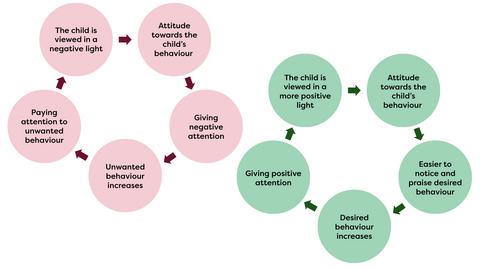
Figure in PDF format.(external link)
Take care of yourself and your coping. Things and actions that increase your well-being and coping:
- What is the smallest thing you can do today?
- Is there a balance between your own and your environment’s wishes and demands? What can you do to improve the balance?
- Know your limits. What could you give up to support your well-being?
- Between the adults in the family, agree on the division of responsibilities and the possibility to have some time for yourself each week.
- How can the family’s support network, the municipality or organisations help with childcare?
How do you deal with negative emotions? If there is a risk that negative emotions will be channelled into negative actions, try the Stop-Think-Act strategy (Mental Hub traffic light technique (pdf, in Finnish)(external link)).
Examine your internal self-talk. When negative emotions take over, think about how you could develop your internal self-talk to be solution-focused. “I’m angry, but I need to calm down because raging isn’t going to lead to anything good.”
Trust in yourself as a parent. You have unique knowledge/experience of your child and are your child’s most important support!
Write down your strengths.
Think of five things you are grateful for every day.
The best support for a child’s/young person’s self-regulation is a parent/adult who is able to receive and accept the child’s emotions and regulate their own emotions and reactions. Positive interaction cycles strengthen parenthood and the interaction between the child and the parent.
Meet your child with compassion where they are, not where you expect them to be.
Strengths-based thinking: Our family’s strengths. What are the things that support and bring joy to our family and help us in the midst of challenges?
Our family’s top 10 strengths (complete the sentences)
- Together, we are good at:
- Our family’s favourite game:
- Best shared holiday memory:
- The parents’ best sides:
- Our family’s signature dish:
- Children know the most about:
- We have learned that:
- Our superpowers:
Managing everyday life and supporting concentration
Children find routines, consistency, regularity and adult guidance important. The experience of being able to manage daily activities creates a foundation for a child's positive self-image.
Successful self-regulation and goal achievement require:
- a direction (goal set for behaviour)
- motivation (desire to work towards the goal)
- capacity (ability to work towards the goal and to overcome obstacles and competing temptations).
When practising the necessary skills, proceeding on the child’s own terms is key. Showing empathy: meet your child where they are, not where you expect them to be.
- Rules: You can support daily life management by agreeing on the family rules, for example, in a family meeting (curfew, homework, chores, bedtime, etc.).
- Clear goals/instructions: When the goals are clear, success can be supported through anticipation, by preparing the environment for the task and explaining what to do in good time.
- Anticipation: The parents have the duty to anticipate situations and regulate their own actions (e.g. if the child is slow to wake up in the morning, make sure to reserve enough time for morning activities).
- Breaking down tasks: To clarify homework and daily activities.
- Visualisation: To create effective routines, make use of lists, calendars and charts related to things such as dressing, eating and washing.
- Importance of feedback: It is important to acknowledge that the child/young person is making an effort and give positive feedback on it. A child/young person builds their good self-esteem on encouraging and positive interaction and feedback.
- A safe atmosphere: where failures are seen as learning experiences.
- Support from loved ones: For a skill to become established, the environment and loved ones must support the child in putting the skill into practice and maintaining it.
Challenging behaviour is easier to manage when you learn to anticipate it and practise acting in various situations in advance in as much detail as possible. What are the situations in our family that trigger undesirable behaviour?
Unexpected changes can be challenging for a child with concentration difficulties. When getting ready for success, it is a good idea to prepare for possible obstacles and make an alternative plan if problems arise. Drawing up an alternative plan can gradually increase the child’s flexibility when faced with changes.
At a grocery shop:
- Discuss with the child in advance how they are expected to behave.
- Pay attention to the child's alertness level.
- Give your child tasks related to collecting and weighing the purchases.
At celebrations:
- Tell the child in advance how they are expected to behave.
- Tell them who will be there, how long the party will last, and what the venue is like.
- Bring something to keep the child occupied/pack a snack.
- Choose a seat that allows you to leave easily if needed.
- Prepare an emergency plan in case you need to leave.
When visiting someone:
- Tell the child in advance how they are expected to behave at the place.
- If needed, bring something to keep the child occupied.
- Focus on positive behaviour by giving praise and encouragement.
- Anticipate the end of play and other activities and the time you leave for home.
- Ask for any fragile items to be moved out of reach of children.
Children with difficulties in concentration/restlessness may find it more challenging to form friendships and may feel excluded.
- Help the child understand and perceive social situations.
- Help the child establish and maintain social relationships.
Perceiving social situations
- Discuss social situations with the child. For example, how to approach others and how to resolve conflicts.
- Put unpleasant experiences and feelings into words. “Kalle is sorry that he broke your toy. He did not handle it roughly on purpose. I'm sure you're feeling upset about it."
You can use visual means, such as the comic strip method, to clarify what happened in the situation.
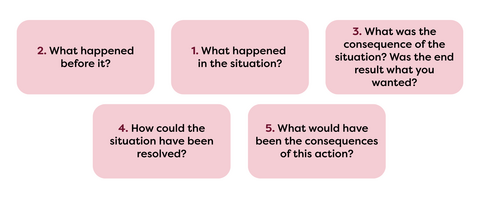
Figure in PDF format.(external link)
Online games, such as the Finnish National Board of Education’s “Tunne-etsivät” (“Emotion detectives”) game(external link), can help children learn how to act in social situations.
Building social relationships
- Suitable location? In what kind of place has the child previously met a new person? Does your child know a child they would like to get to know better?
- Suitable situation? Recess, afternoon club activity, hobby?
- Suitable words? What could I tell them about myself? What could I ask the other person?
- See the Mental Hub’s Nepsy-piirteisten lasten omahoito-ohjelma (Self-care programme for neurodivergent children)(external link) for printable question cards and getting-to-know-you cards.
Rewarding skills practice
Incentive-based plans are the best way to increase motivation for both household chores and school assignments. Rewarding aims to guide the child’s activities in the desired direction and give them instant feedback.
- External motivation vs. internal motivation
- The younger the child, the greater the need for external support strategies
- As the child grows, the goal is to strengthen and increase internal support strategies (skills)
Rewarding can be used to practice new skills, such as doing homework, packing a backpack, brushing teeth or sticking to the curfew. Pay attention to the words you use when rewarding and praising the child: "Well done!" vs "Thank you for hanging your coat on the coat rack!"
Tips for rewarding
Together with your child, talk about what skill is being practised. Pay attention to making sure that the goal is achievable. Agree on a reward the child gets for 3–5 successes. For example, the reward can be some fun activity you can do together (at the beginning, you can reward the child for just trying).
Choose a method that the child likes to mark each time the child achieves the goal, for example with a sticker or stamp. NOTE! Once earned, successes are not taken away and the rules are not changed midway through the practice.
See the Mental Hub website for a reward chart:
Reward chart | Mental Hub (only in Finnish and Swedish)(external link)
You can also use the reward chart with a young person:
Reward chart for young people | Mental Hub (only in Finnish and Swedish)(external link)
Weekly schedule, situations involving transitions
Create a predictable, repetitive daily and weekly routine. Place the weekly schedule somewhere visible in your home. Go through the schedule for the coming days together.
- Visual guides are available online, for example Visual materials - Papunet(external link)
Create a predictable, repetitive daily and weekly routine. Place the weekly schedule somewhere visible in your home. Go through the schedule for the coming days together.
Anticipate situations; let the child know about an upcoming transition, such as from play to a meal or from a snack to homework, 10 minutes and 5 minutes before it takes place.
Use a visual step-by-step guide to support daily activities. If necessary, add a movable blue tack or magnet on top of the instructions to show the current stage of the activity.
Examine the number of activities in the weekly schedule - what is a suitable number of recreational activities and meetings with friends, what is a suitable amount of rest and time without plans.
Homework etc.
- Breaking down tasks: Break down large tasks into smaller, more manageable parts to make it easier to get started.
- Come up with a suitable, sufficiently small goal so that it is achievable and strengthens the experience of success (e.g. a realistic amount of time the child can successfully spend on homework at one time or a specific cleaning task, such as vacuuming or putting laundry in a laundry basket).
- Reinforce the achievement of the selected goal with positive feedback, e.g. a reward chart for successfully carrying out evening activities or doing homework.
- Visual timer: Time Timer or a similar aid helps the child see the passage of time and the duration of the task in a concrete way.
- Taking breaks and engaging in movement Take regular breaks and allow the child to move their body (e.g. an exercise ball as a chair or an active sitting cushion).
- Remember to reward and praise the child for their successes, including minor ones; the positive cycle lowers the threshold for doing homework and makes it easier to apply skills.
Mobile applications that support executive functions
Inventioneers: To practise executive function and concentration skills
Visual timer and Mouse Timer: Visualise the passage of time
Timo Routine Visual Timer: Creates structures for daily routines and adds times and alarms to remind of the passage of time and the transition from one activity to another
1Money: To help understand how to use money
Chillaa: To reduce stress, tension and anxiety
Sensory regulation
Make observations on the sensory environment at home;
- What is the place like where the child likes to do their homework at home; are they surrounded by attractive stimuli, does the child want to fidget with something while doing their homework, or do they prefer to read while lying down or sitting at a table, what kind of clothes do they feel comfortable in, does the adult's presence support the child’s schoolwork?
- Is there a lot of background noise at home (e.g. radio or television on) that might cause overload? Is the child surrounded by a lot of items that may catch their attention (e.g. toys near the dining table, etc.)?
- Reserve moments of calm in your daily life, and also build them into your routine; walking in nature together, bathing in the sauna, a moment to relax in the evenings, shared reading time.
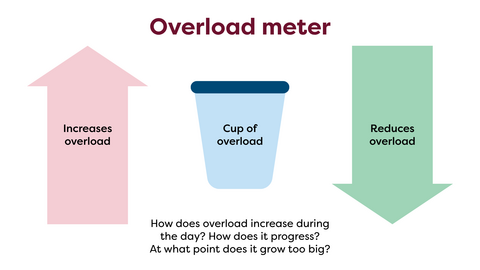
Regulating overload
Overload emerges due to, for example,
- Demands
- Too high or unclear demands
- Amount of things to do
- Too many stimuli and activities
- Changes
- Sensations
- For example, loud noises, bright lights, strong smells, cold/hot sensations in the body
Identifying the factors causing overload, for example by asking the child/young person about them, and for younger children, suggesting possible causes and reflecting on them together
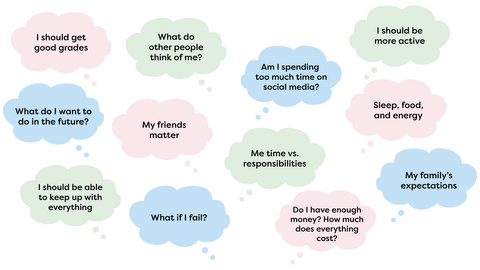
Figure in PDF format.(external link)
Recognising overload
- outward behaviour (irritability)
- turning inward (withdrawal)
Examples of how this can be seen at home: the child/young person is:
- restless and wound up
- anxious and tearful
- irritable and quick to get angry
- tired
- in pain/aches.
Tips for preparing in advance
- anticipation
- routines
- clear instructions, broken down into smaller parts
Tips for supporting yourself during overload
- adult support to help with self-regulation (presence)
- massage/stroking
- silence
- listening to music
- drawing
- focusing on personal interests
Tips for providing support after the overloading situation has passed
- Joint discussion with the child/young person – an opportunity to gain mutual understanding
Calming down and relaxing
Alertness = level of alertness and attentiveness
Different levels of alertness help people function in different situations:
- To fall asleep, your alertness level should be low.
- In physical activity, increased alertness is helpful.
- Alertness levels often vary during the day.
- Recognising the child’s/young person’s alertness level can help guide them to an alertness level suitable to their current activity.
Below are some ways to regulate the alertness level, from over-alertness to calming down:
Factors that reduce alertness:
- breathing techniques where the exhale is longer than the inhale
- a calm environment without distractions
- reduction of sensory stimuli
- chewing chewy or hard foods and sucking with a straw
- strong, calm muscle activity
- adding heat.
Example of a bedtime relaxation exercise for a child
Lie down on your back in bed. Close your eyes.
You can put your comfort toy or your hands on your stomach and feel how your stomach moves.
Feel how your breathing makes your stomach rise and fall.
Be calm as the moon in the night sky. Be as quiet as a rabbit sleeping in a bush.
Notice that your hands feel heavy and calm, like the branches of a spruce tree.
Each finger is completely still.
Your legs feel heavy, like big stones.
Notice how a blanket of sleepiness and calm settles over your body.
A wise owl whispers to you: “This is a good and safe place to be. You can sleep, I'll keep watch."
Sourve: A relaxation exercise for children - Neuvokas perhe - Finnish Heart Association(external link)
Chillaa application
The Chillaa app helps with anxiety, tension and stress. It is an app, or mobile application, aimed at young people from the age of lower secondary school onwards. Chillaa was developed together with young people. It helps to relieve stress and tension and to build confidence.
The Chillaa app includes:
- relaxation and mindfulness exercises
- tips for tricky situations
- encouragement from other young people.
Chillaa encourages you to take control of your mind and helps you face difficult situations. It was designed to make it easier to cope with the challenges of school, everyday life and hobbies. It aims to reduce stress, nervousness and anxiety. It also makes it easier to face social situations.
Download the Chillaa application for free (in Finnish):
Self-care programmes for families with children | Mielenterveystalo.fi (in Finnish)(external link)
- Challenging behaviour
- Friendship skills
- Sleep difficulties
- Eating problems
- Interaction between the child and the parent
- Self-care programme for neurodivergent children
- Self-care programme for parents of a child experiencing difficulties
Self-care programmes for young people | Mielenterveystalo.fi (in Finnish)(external link)
- Self-care programmes for young people with concentration difficulties
- Sleep difficulties
- Eating problems
- Friendships
- Self-esteem and identity problems
If you are still concerned about the topic, you can get help and advice from a student welfare worker at your child’s pre-primary school/school.
Services provided by the wellbeing services county
Student welfare services
Everyday support services for families with children
Mental health and psychologist services for children and young people
Rehabilitation services for children and young people

Explore the wellbeing services near you
Is your school-aged child getting enough sleep, should you intervene in your teenager's screen time usage? Omaperhe provides information, support, and guidance for all family situations with children!